Blowing the reno budget is never fun. Follow this handy savings guide and find out what you can scrimp on and what you should splurge on.
Cooper & Co
Published on: 21 Mar, 2019
Blowing the reno budget is never fun. Follow this handy savings guide and find out what you can scrimp on and what you should splurge on.

How to save money on a renovation
Coming in under budget on a renovation is everyone’s dream. The reality, though, is often very different, even when you’ve done what all the experts tell you and factored in unforeseen extras. However, cutting costs without compromising on your dream reno is possible with some thorough research, clever planning and good organisation.
Minimise plumbing changes
Keep the position and layout of bathrooms and kitchens roughly the same because moving plumbing isn’t cheap as it involves removing wall linings and making holes in flooring. Group the laundry, bathrooms and toilets together. If you have to reposition something, try to keep the move to a minimum.
Keep the same footprint
Building within the existing building footprint is the most cost-effective way to renovate. If you’re hoping to extend, make sure the foundations are up to it before you buy a property. Replacing them is expensive.
Paint floors rather than replace them
If floors are in bad shape or only covered in particle board, paint them with water-based enamel until you can afford better quality flooring.
Do your prep
Well before the builders arrive, get out to the hardware stores and builder’s depots to make sure you are very clear about what appliances and fixtures you want and what they cost. You need to brief your builder, electrician and other contractors precisely on these to avoid problems further down the track. Having to redo wiring after the walls have been lined because you wanted dimmer lights but didn’t advise the electrician can be very expensive.
Who does what?
Nowadays many contractors specialise in just one area – wall linings or joinery, for instance. Having regular conversations with tradespeople can avoid confusion.
Moving or removing walls costs money
Only knock out walls if it’s absolutely necessary. Sometimes moving just one wall will be enough to create a more open feel. Adding walls costs more, so if the space is too open-plan for your tastes, consider using furniture, flooring, rugs or screens to define different areas.
How to save money on lighting
Using track-, wall- or ceiling-mounted lighting, rather than recessed fittings, saves you money on labour (including cutting holes in the wall and ceiling) as well as the cost of fittings.


Organise your trades
Builders generally have their own preferred subtrades that they will organise, but if you are running the project yourself, figuring out who is responsible for each stage can be tricky. It’s cheaper and more efficient for each trade to come in at the right time, rather than having them come backwards and forwards or – even worse – all at the same time. This means having everything each contractor needs on site before they get there.
Don’t panic about sales
Some homeowners prefer to buy building materials and appliances on sale in advance of the build and keep them in storage until they are needed. Be aware, though, that things can change during construction and your pre-purchased appliances might not suit further down the track.
Aim to use standard sizes
Custom-made doors, windows and cabinetry are much more expensive than standard sizes. And it’s a lot cheaper to line rooms that are designed around the standard sheet size of plasterboard or plywood. Cutting and fitting them for odd-shaped rooms is also time-consuming and therefore expensive.
Materials matter when it comes to saving
Use materials such as Triboard, ply or grooved Ecoply lining which can simply be painted, instead of plasterboard which needs plastering as well as painting. That way, you eliminate at least one contractor.

Re-purpose furniture you already own
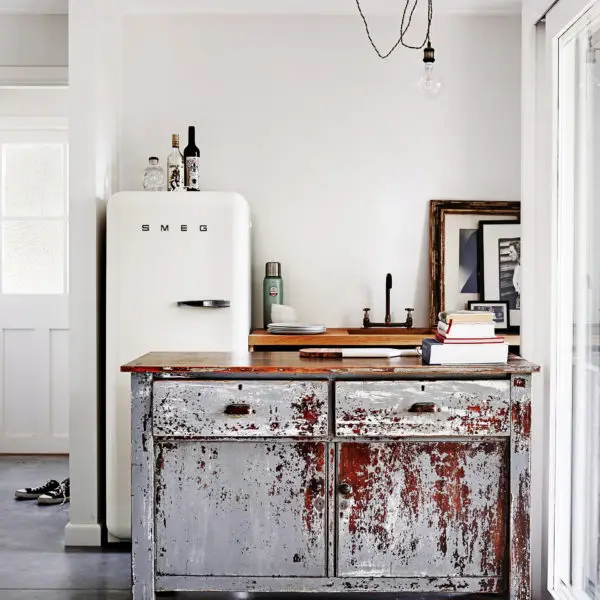
If you’ve got a good eye, look for interesting pieces of furniture that can be re-purposed as a kitchen island or bathroom vanity. Alternatively, buy secondhand kitchen or bathroom vanity cabinets online or from building supply auctions. Update the benchtop or the basin if necessary for a more contemporary look.
Get clever with cabinetry
Kitset cabinetry is cheaper than custom-made and you can always spend a bit more on the benchtop to give the kitchen some wow factor. Also, consider reusing the existing carcass and adding new doors and drawer fronts. As an alternative to extending the entire kitchen, try upgrading existing cabinetry with more space-efficient dividers, shelving and pull-out trays
Use paint to transform a space
Paint can instantly transform a space for not a lot of money. It’s cheaper to buy unfinished kitchen cabinetry and doors and paint them yourself if you have time. Make sure you work out exactly how much you need as it’s easy to over-order paint. Busy paint trade centres will often sell mis-tinted paint cheaply but always buy a premium brand.
Go mid-range with appliances
You don’t need to spend a fortune to get good appliances – there are some well-priced mid-range appliances on the market that offer top-of-the-line features. We love the new Haier French Door Refrigerator – it has a sophisticated look and feel, fits more than a standard fridge including full-width platters, and has adjustable coolness control for crispness.
Install light shafts
For dark bathrooms or hallways, rather than cutting holes in the cladding and rearranging framing for windows, or installing skylights in the ceiling, consider a light shaft or tube. It will be easier to install and cost a lot less.
Buy it yourself
When contractors pick up fixtures and fittings, they’ll often add a margin. Go to the supplier and pick them up yourself instead.
And buy right
Do your research on where to buy those materials and fixtures. Most retail showrooms have end-of-line or clearance sales on a regular basis. Try outlet stores, ‘factory seconds’ shops and stores that sell discounted display stock of curtains, lights and bathroom fittings. Check out the big-box hardware stores, too – the selection and quality are improving all the time.
Words by: Carol Bucknell. Homestolove.co.nz
Photography by: Chris Warnes and Sharyn Cairns
The post How to save money on a renovation appeared first on Cooper & Co.
New Zealand’s property market may be shifting from a buyer’s market to a seller’s market, driven by greater buyer demand – in particular from first home buyers taking advantage of favourable h...
Read moreWith the Reserve Bank of New Zealand holding the Official Cash Rate (OCR) at 5.5 per cent in October 2023, borrowers are having to get used to higher interest rates and mortgage repayments, as a drop ...
Read moreWe are delighted to share that Harcourts has been honoured with the Reader’s Digest Quality Service Gold Award in Real Estate Agencies for the seventh consecutive year. This prestigious recognit...
Read moreDiscrimination is unlawful under tenancy law when it breaches the Human Rights Act.There are 13 Prohibited Grounds of Discrimination from Section 21 of the Human Rights Act 1993:1. Sex, including preg...
Read moreA National government means changes to the private rental sector, as the National party pledged in April 2023 to revoke two of Labour’s controversial tenancy law changes; “National has already com...
Read moreFamily Violence Regulations took effect at the end of December 2022, meaning that if a tenant had been subjected to family violence, they can provide their landlord with at least two days’ written n...
Read moreBe the first to hear what's happening with NAI Harcourts. Subscribe to our mailing list.
Share